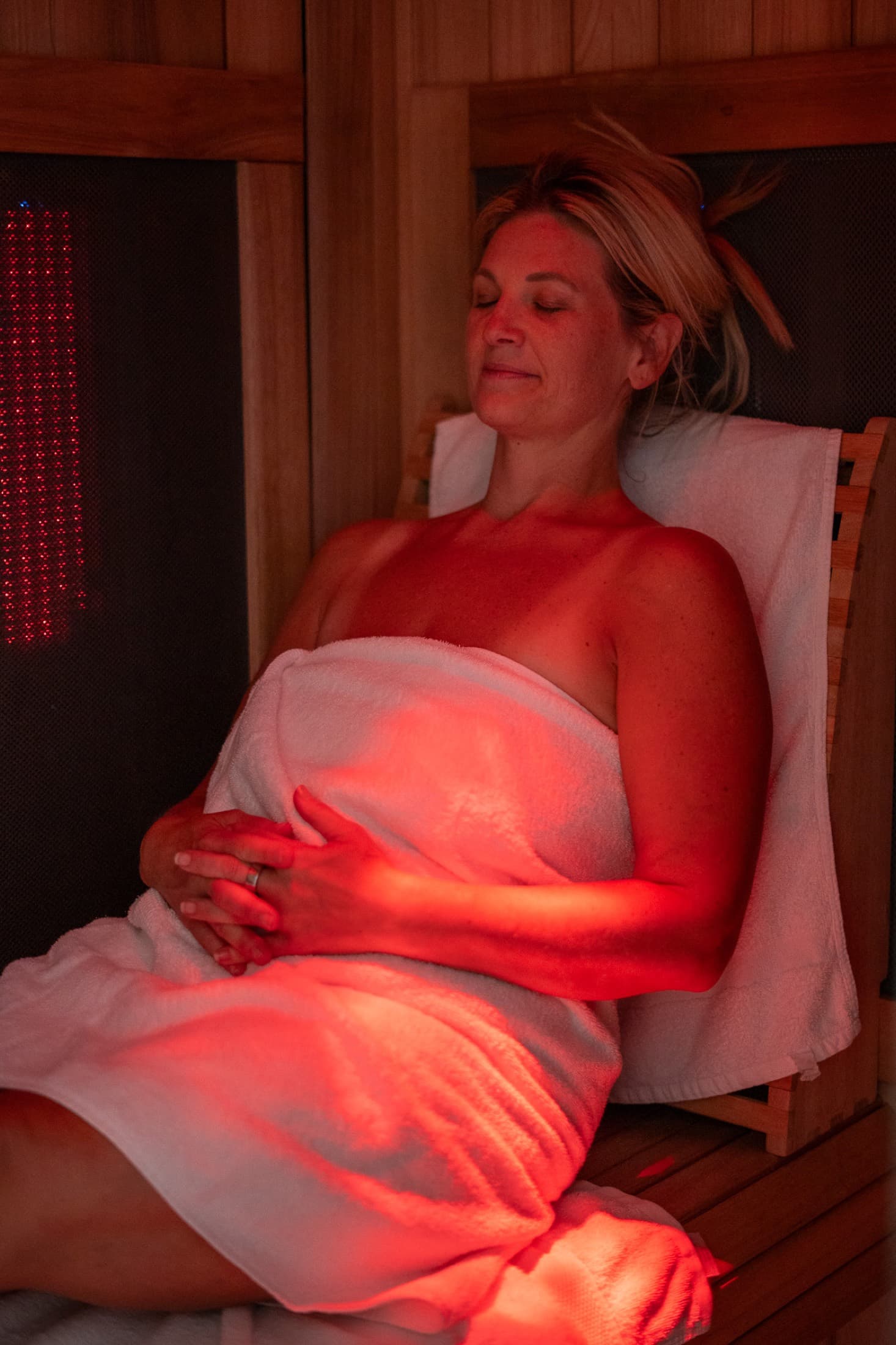
The Language of Wavelength: How Light and Heat Speak to the Cell
Red light and infrared heat aren't simply wellness comforts — they're precise biological signals. Here's what the science says about how they're received.
There is a certain irony in the fact that two of the most ancient therapeutic forces available to us — light and heat — are now among the most rigorously studied tools in modern longevity science. We have been drawn to warmth and sunlight for as long as we have been human. What's newer, and genuinely compelling, is our growing ability to describe precisely what is happening at the cellular level when we expose ourselves to them intentionally, at the right wavelengths and temperatures, in calibrated doses.
This is not metaphor or folk wisdom. It is photochemistry, thermobiology, and mitochondrial physiology — and the picture that emerges from that research is worth understanding on its own terms.
When the Cell Receives the Signal
Not all light interacts with tissue the same way. Ultraviolet wavelengths carry enough energy to damage DNA. Visible blue light suppresses melatonin and disrupts circadian timing. But red light — roughly 630 to 700 nanometers — and near-infrared light in the 700 to 1,100 nanometer range occupy what researchers have come to call a therapeutic window: wavelengths that penetrate biological tissue without damaging it, and that interact with specific cellular structures in ways that appear to be profoundly restorative.
The mechanism centers on the mitochondria. Within the mitochondrial respiratory chain sits a protein called cytochrome c oxidase — the terminal enzyme responsible for converting nutrients into ATP, the cell's primary energy currency. Cytochrome c oxidase is also, crucially, a photoreceptor. When it absorbs red or near-infrared photons, it displaces nitric oxide that has been suppressing its function — a particularly meaningful effect in aging or chronically stressed cells, where that suppression tends to accumulate. With that inhibition lifted, the mitochondria resume more efficient ATP production, and the downstream effects ripple outward: enhanced protein synthesis, accelerated DNA repair, modulated inflammation, and improved antioxidant expression.
The cell doesn't distinguish between ancient sunlight and a clinical-grade panel. It reads the wavelength and responds accordingly.
Near-infrared light penetrates considerably deeper than red light — up to 40 or 50 millimeters — reaching muscle, connective tissue, and in some delivery configurations, structures well beneath the surface. This differential depth is part of why therapeutic protocols typically combine multiple wavelengths: different tissues require different reach.
What Infrared Heat Adds to the Conversation
Infrared sauna operates through a related but distinct mechanism. Where a traditional steam sauna heats the air around you until the body responds, infrared wavelengths are absorbed directly by tissue — raising core temperature more efficiently, at lower ambient temperatures, and with a depth of penetration that a hot room alone cannot achieve.
The physiological response to that deep, radiant heat is broad. Core temperature elevation triggers robust vasodilation, increasing blood flow to peripheral tissues and driving improvements in endothelial function — the health of the inner lining of blood vessels. A recent narrative review (Hachem et al., 2025) examined the evidence around sauna bathing and cardiovascular health, noting that repeated passive heat exposure is associated with measurable improvements in vascular tone, autonomic regulation, and markers of systemic inflammation. These are not trivial endpoints; they sit close to the root causes of the chronic disease burden that defines aging for most people.
The heat stress response also activates heat shock proteins — molecular chaperones that help refold damaged or misfolded proteins, a process increasingly understood to be central to cellular resilience and longevity. Regular activation of this pathway appears to support the kind of proteostasis, or protein quality control, that declines with age and contributes to the cellular dysfunction that underlies many age-related conditions.
The benefits associated with infrared heat and photobiomodulation include, among others:
- Reduced markers of systemic inflammation
- Improved endothelial function and circulation
- Enhanced mitochondrial efficiency and ATP output
- Accelerated tissue repair and recovery from physical stress
- Activation of heat shock proteins and antioxidant pathways
- Improved sleep architecture and parasympathetic recovery
Restoration as a Biological Practice
There is a tendency, in wellness culture, to frame restoration passively — as something that simply happens when you stop doing things. Rest. Sleep. Stillness. And those matter enormously. But what the science of infrared sauna and red light therapy suggests is that restoration can also be an active biological process: a deliberate set of signals sent to the cell that initiate repair, improve efficiency, and build a kind of resilience that accumulates over time.
This is the distinction worth holding onto. Not every restorative modality is asking the body to do nothing. Some are asking it to do something very specific — to upregulate the repair machinery, clear the metabolic debris, and reset the systems that chronic stress, poor sleep, and the ordinary entropy of modern life tend to degrade. Light and heat, applied with intention and consistency, appear to be among the more eloquent ways we have of making that request. The cell, it turns out, has been listening to these signals for a very long time.